This article is published in Aerospace Daily & Defense Report part of Aviation Week Intelligence Network (AWIN), and is complimentary through Apr 17, 2026. For information on becoming an AWIN Member to access more content like this, click here.
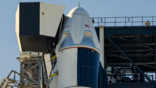
The well-bonded Artemis II crew (clockwise from left) Christina Koch, Jeremy Hansen, Reid Wiseman and Victor Glover were headed back to Earth to conclude a nine-day flight test of NASA's deep-space Orion capsule.
HOUSTON—NASA’s record-setting Artemis II flight test around the far side of the Moon was drawing to a close on April 9, with a final, critical objective: a Mach 32 reentry into Earth’s atmosphere and splashdown in the Pacific Ocean.
With four astronauts aboard, the Artemis II Orion spacecraft Integrity was due to hit the outer fringes of Earth’s atmosphere at 7:53 p.m. EDT April 10 at an altitude of 400,000 ft. The ship will be traveling at about 25,000 mph and aiming for a splashdown about 200 mi. off the coast of San Diego, some 1,960 mi. away.
As Integrity plunges into the densest parts of the atmosphere, temperatures around the ship will climb to 4,000-5,000F, creating a cloud of ionization that blocks communication with ground controllers for six min.
Integrity will conduct two automated roll-reversal maneuvers to bleed off speed, setting the stage for a system of 11 parachutes to deploy to slow the spacecraft’s descent to 19 mph.
Splashdown is expected at 8:07 p.m. EDT to complete the first crewed flight of an Orion spacecraft and the first flight of astronauts beyond Earth’s orbit since the final Apollo Moon mission in 1972. Integrity traveled as far as 252,756 mi. from Earth, setting a new distance record for a crewed spacecraft, and will rack up nearly 700,000 mi. in total, from launch to splashdown.
“When a mission goes well, it can look like flying to the Moon is easy. It certainly is not. We can’t forget this is a test flight and that we are taking everything forward to support the next mission,” Lakiesha Hawkins, deputy associate administrator of NASA’s Exploration Systems Mission Directorate told reporters on April 8.
“This is a good mission so far, and we are nearing the end, having retired a significant number of risks over recent days. But the team remains focused and is making sure we don’t take our eye off the ball,” she said.
Pleased with Integrity’s performance since its April 1 launch from the Kennedy Space Center, NASA has expressed confidence it has adjusted the reentry profile to address heat shield damage concerns that arose following the Artemis I uncrewed flight test in 2022.
Post-flight inspections of the Artemis I heat shield showed it had not ablated as expected during atmospheric reentry. The shield’s protective ablative material cracked and broke away in small chunks.
Orion heat shields for future crewed missions were redesigned, but not the heat shield used for the Artemis II flight. Instead, NASA modified the reentry profile to mitigate the duration of peak heating on the shield.
“Every system we have demonstrated over the past nine days—life support, navigation, propulsion, communications—all that depends on the final minutes of flight,” NASA Associate Administrator Amit Kshatriya told reporters on April 9.
“We have high confidence in the system, heat shield, parachutes and recovery systems we put together. The engineering supports it, the Artemis I flight data supports it, all of our ground tests support it, our analysis supports it, and tomorrow the crew is going to put their lives behind that confidence,” he said.
Integrity’s return to Earth began on April 2 with a 5 min.-50 sec. translunar injection burn that sent the ship on an eight-day loop around the Moon and back, a trajectory shaped by the gravity fields of Earth and the Moon.
Orion’s European Space Agency-provided service module is to separate about 20 min. before atmospheric reentry. If needed, Integrity’s flight path angle can be adjusted with a raise maneuver prior to reentering the atmosphere.
The weather forecast for the primary splashdown site remained favorable, NASA said on April 9.
The U.S. Navy, which deployed its USS John P. Murtha recovery vessel from San Diego on April 7, shoulders a critical role post-splashdown. Once cleared by NASA Mission Control, Navy divers will approach the capsule to assess any hazards and then open its hatch to assist the astronauts into an inflatable raft. The raft will be towed away to a pair of awaiting helicopters. One by one the astronauts will be lifted aboard the helicopters and flown to the recovery vessel for initial medical checks, according to Liliana Villarreal, NASA’s Artemis II landing and recovery director.
“We expect to recover the crew and deliver them to the medical bay within two hours of splashdown,” Villarreal said. “Orion will be towed into the well deck of the recovery vessel, which will then begin its return to Naval Base San Diego, which is expected to take 12-24 hr.”
The Artemis II crew will be transported to the Johnson Space Center for post-flight medical care, while Integrity will be transported to the Kennedy Space Center for post-flight inspections.