This article is published in Aerospace Daily & Defense Report part of Aviation Week Intelligence Network (AWIN), and is complimentary through Apr 08, 2026. For information on becoming an AWIN Member to access more content like this, click here.

CAPE CANAVERAL—Countdown clocks at the Kennedy Space Center began ticking down toward launch of NASA’s Artemis II flight test, marking the long-awaited crewed debut of the Orion deep-space capsule on the first human spaceflight beyond Earth's orbit since 1972.
With no technical issues pending and a favorable weather outlook for launch, NASA began a 49-hr. 40-min. countdown at 4:44 p.m. EDT March 30. Liftoff of the agency’s second Space Launch System (SLS) rocket is targeted between 6:24 p.m. and 8:24 p.m. on April 1.
“There are no issues from preventing us from pressing ahead at this point,” NASA Associate Administrator Amit Kshatriya told reporters late March 30. “The teams are in a strong posture, and the mission remains on track.”
Meteorologists at Cape Canaveral SFS’s Space Launch Delta 45 forecast an 80% chance of acceptable weather conditions for an April 1 launch attempt. The primary concerns are cloud coverage and the potential for high winds, NASA said.
The four-member Artemis II crew remains in a routine prelaunch medical quarantine at the Kennedy Space Center ahead of flight. “They have been following a controlled sleep schedule and nutrition plan to maintain energy and hydration for launch, while continuing to receive regular updates on the rocket’s configuration and weather conditions,” NASA noted in a mission status update.
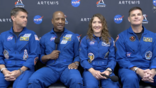
The crew is led by NASA astronaut Reid Wiseman and includes NASA’s Victor Glover and Christina Koch as well as the Canadian Space Agency’s Jeremy Hansen. The quartet are expecting to spend nine days in space, eight of which are to be spent traveling to and from the Moon.
Following a 25-hr. checkout in Earth orbit, the crew’s Orion spacecraft is expected to put itself on a trajectory that will travel nearly 252,800 mi. beyond Earth. If that happens, Artemis II will top the distance record set by the Apollo 13 crew in 1970.
Artemis II follows the November-December 2022 uncrewed Artemis I flight test. It is expected to kick off a newly revamped series of missions intended to fast-track U.S and partner countries’ presence and access to the Moon. NASA is eyeing early 2028 for the first crewed landing on the Moon since Apollo 17 in 1972.

Related Content