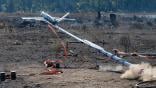
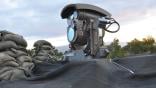
Small drones now enforce a 10-15-km “kill box” on both sides of the front lines.
On stage before hundreds of American artillery officers, Ukrainian Maj. Gen. Volodymyr Horbatiuk started by showing a video taken with his cell phone on Feb. 24, 2022, the day Russia launched the wide-scale invasion of his country.
In the video, the camera pans across an unnamed crossroads somewhere in Ukraine. Littering the roadside are the smoking ruins of Russian tanks and armored vehicles. Ukrainian infantry soldiers, including some holding antitank missile launchers, file past the broken armored column.
- In March, Russia fired fewer missiles than Ukraine
- Ukrainians are mass-producing a midrange, deep-strike drone for “strategic-level” attacks
Although it is less than five years old, Horbatiuk’s video chronicles a style of warfare—dynamic, armored, close and human—that has long disappeared from the battlefields of Ukraine.
“That video, I think that is a good start to show where we started; how we were using traditional weapons, including antitank, missiles, etc., [and] the traditional tactics of using artillery,” Horbatiuk said April 14 at the Fires Symposium, an annual event hosted by the U.S. Field Artillery Association and the Air Defense Artillery Association. “And I will try to now explain how we evolve from the efficient utilization of traditional weapon [systems] to massive unmanned system usage.”

Legions of Ukrainian-designed, one-way attack drones now roam deep inside Russian territory, inflicting damage on Russia’s oil infrastructure and defense industry.
An even larger cadre of midrange drones are being launched by Ukraine at targets up to 222 km (138 mi.) behind the front lines, targeting military repair depots and airfields in what had been a sanctuary for Russia’s combat support forces, Horbatiuk said. The close fight on the front lines continues to evolve rapidly, with artillery camouflaged and banished miles behind the trenches while the firepower role is largely ceded to drones.
The momentum in the war has flipped back and forth several times in the past four years. Russia’s initial onslaught quickly conquered more than a quarter of Ukrainian territory. Kyiv’s forces—bolstered by an influx of billions of dollars’ worth of Western armaments—pushed the Russians back from the outskirts of the capital, then drove the invaders from Kharkiv and Kherson. A burst of innovation in aerial drones by Ukraine held back Russia’s offensives in 2024, then helped Kyiv withstand Russia’s drone-fueled response in 2025.
Heading into the fifth year of the war, Horbatiuk’s comrades face another bloody season of summer offensives but stand in a solid position.
“I actually think that Ukraine is in a much better place than it has been at any stage in this horrific war,” Finnish President Alexander Stubb said at an April 13 event at the Brookings Institution in Washington.
Ukrainian forces appear to have retaken the initiative this spring against Russia after a costly and brutal effort to survive Moscow’s repeated offensives in 2025 that yielded marginal territorial gains.
In some ways, the operational picture remains grim. Russian troops still occupy 19.3% of Ukrainian territory, including the Crimean Peninsula and most of the Donbas region. And a sustained, long-range bombardment of Ukraine shows no signs of relaxing. Russia mounted the largest aerial attack of the war on March 23-24, launching 950 drones and dozens of missiles at Ukraine. Russia then fired another 700 drones and 40 missiles at the country on April 16. In both cases, the defenders intercepted the vast majority of the drones.
Ukraine also counted more than 17,000 long-range projectiles launched by Russia in both the third and fourth quarters of 2025, an average of nearly 200 attacks a day deep behind the front lines, said Horbatiuk, the Ukrainian military liaison to the U.S. military’s Security Assistance Group-Ukraine, which is observing the war to gather lessons for American land forces.
Despite that onslaught, Ukraine now may have the advantage in long-range aerial attacks. “In the month of March, there were more drones and missiles flying from Ukraine to Russia than they were coming from Russia to Ukraine,” Stubb said.
The pressure is now on Moscow to sustain a bloody pace of offensive maneuvers this summer. Russian forces sustained 400,000 casualties in 2025 in return for taking an extra 1% of Ukrainian territory, Stubb said. Since December, Ukrainian forces have killed 35,000 Russian troops each month, he added, noting that 95% of the deaths are caused by drones. The rate of attrition equals about 157 Russian soldiers killed for every kilometer seized. If the loss rate holds, Russia would have to sustain 800,000 more casualties to conquer the rest of the Donbas region in eastern Ukraine, Stubb said.
“Russia is not able to recruit enough soldiers to compensate,” he said.
The vast majority of military casualties take place in the “close fight” area of the battlefield, a region extending about 15-20 km behind the front lines on both sides. It is sometimes characterized as a World War I-style system of opposing trenches, with lines of dug-in troops facing each other across a desolate no-man’s land. The reality is very different, Horbatiuk, a career infantry soldier, said.
“I can tell you now on the front line that we don’t have traditional trenches or a traditional front line,” Horbatiuk said. “I think we’re using infantry mostly as a system of observation posts.”
In that sense, the space on both sides is occupied mainly by ground and aerial drones. Soldiers are present in small numbers to observe drone and enemy movements. Horbatiuk presented a captured manual of Russia’s Rubicon complex, which in late 2024 fielded a system of launching millions of armed, short-range drones at Ukrainian troops and front-line infrastructure.
The manual shows that Russia posts the operators of the short-range drones about 15-20 km behind the front lines, aiming to keep them back far enough to survive. A network of “sappers,” or engineers, occupy positions about 10-15 km behind the front lines. Their job is to service the drones during a mission, recharging their batteries or switching their payloads as close to the front lines as possible.
On the Ukrainian side, artillery systems have been moved back to camouflaged positions up to 10-12 km behind the front lines, Horbatiuk said. In an effort to prevent a single salvo of Russian drones from wiping out multiple systems, Ukrainian cannons are spaced at least 2 km apart. Those positions improve the chances that the artillery systems will survive but create other problems. The range of the Ukrainian cannons is limited to 14.6 km, so they can strike positions only on the thinly occupied tip of Russian-held territory along the front. Those limitations have forced both sides to rely on an ever-expanding supply of drones for aerial attacks.
“Artillery still matters, tanks still matter, and our personal carriers still matter,” Horbatiuk said. “But we need to think how to change the tactics of how we use them.” With the area around the front lines heavily contested, Russia masses troops, supply depots and headquarters units in an area that extends 20-300 km away from Ukrainian-held ground.
During the first year of the war, Ukraine had no reliable weapons to attack those midrange areas. The Biden administration approved transfers of Lockheed Martin Army Tactical Missile Systems (Atacms) to Kyiv, which prompted Germany to donate air-launched Storm Shadow cruise missiles.
Although the supply was limited, Ukraine has made good use of them, Horbatiuk said. In combination, both missiles have engaged 152 targets, with a 70-80% success rate. The most common targets engaged by the Atacms were Russia’s air defense sites, representing 54% of all successful missile strikes. Most Storm Shadow air strikes focused on command and intelligence hubs, representing 56% of successful launches, Horbatiuk said.
With stocks of Atacms and Storm Shadows dwindling, Ukraine began developing and importing midrange strike drones. Those new platforms—named by Horbatiuk as Fire Point-1 and -2, FD-29, Morrigan, CAT-6 and E-300—now have reached Ukrainian units in mass quantities. Ukraine launched 1,588 midrange drones to engage 408 targets between December and March, Horbatiuk said, including 222 targets hit in March alone. The longest-range strike was aimed at an SA-23 radar in Crimea, which was located 212 km from the Ukrainian launch site, he noted.
Lacking even longer-range systems, Ukraine also uses drones for “strategic-level” deep-strike attacks within Russia, Horbatiuk said, noting that drones accounted for 98% of all strategic-level attacks in 2025 and so far in 2026.

Related Content