This article is published in Aviation Daily part of Aviation Week Intelligence Network (AWIN), and is complimentary through Apr 22, 2026. For information on becoming an AWIN Member to access more content like this, click here.

A system designed to flag imminent runway incursions at New York's LaGuardia Airport (LGA) did not alert air traffic controllers before the March 22 fatal collision between a fire truck and a regional jet, likely because the truck was not equipped with a transponder that relayed its precise movements, information revealed by NTSB suggests.
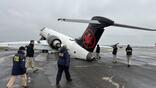
LGA’s Airport Surface Detection Equipment, Model X (ASDE-X) ground safety system did not detect the airport rescue and firefighting (ARFF) vehicle’s movement towards Runway 4/22 as an Air Canada Express CRJ-900 touched down on the same runway, NTSB Chair Jennifer Homendy said in a March 24 briefing.
“ASDE-X did not generate an alert due to the close proximity of vehicles merging and unmerging near the runway, resulting in the inability to create a track of high confidence,” Homendy said, quoting an FAA analysis of ADSE-X data from the accident.
The ARFF vehicle, call sign Truck 1, was leading a group of several first responders to another incident involving a United Airlines aircraft parked on the other side of the airfield. Truck 1 asked for permission for “Truck 1 and company”—meaning it and the trailing vehicles—to cross Runway 4 at Taxiway D. The LGA tower controller initially granted the request, then canceled it when he realized the truck would cross in front of an arriving CRJ-900, Air Canada Express Flight AC8646, that was cleared to land.
A preliminary NTSB analysis of the cockpit voice recorder (CVR) and other data shows Truck 1 was cleared to cross the runway 12 sec. before Flight AC8646 touched down.
But 11 sec. later, or just as the CRJ’s wheels were reaching the runway, the controller tells Truck 1 to stop. The controller makes a second, urgent call for Truck 1 to stop about 5 sec. after the CRJ landed.
The CVR stops recording 8 sec. after touchdown.
CCTV footage shows Truck 1 moving from the hold short line onto the runway. It took about 9 sec. to get from the hold short line to the runway edge—a distance of about 200 ft. It entered the runway about 3 sec. before impact.
The video shows the trailing vehicles stopping about 5 sec before impact—around the time of the controller’s second urgent call.
None of the emergency vehicles were equipped with vehicle movement area transponders (VMATs) or similar technology that provide pinpoint position and speed data. While not required, the FAA “encourages” VMATs, particularly at airports with Surface Awareness Initiative (SAI) systems such as ASDE-X, which combines several data sources, including ADS-B and radar, and displays real-time surface area status to controllers.
“At airports equipped with SAI systems, the position and call sign of aircraft equipped with ADS-B and vehicles equipped with VMATs are shown on surface displays in the ATC [air traffic control] tower,” a 2025 FAA CertAlert advisory said. “Ground vehicles without VMATs are not displayed.”
Radar that feeds ASDE-X tracks ground vehicles, but not as accurately as VMAT-equipped vehicles.
At LGA, the group of emergency vehicles responding to the United incident showed up on ASDE-X as “two blobs,” Homendy explained. “Two targets with radar returns on Taxiway D.”
Neither one is shown moving onto the runway, she added.
ASDE-X is equipped to alert controllers when an imminent collision threat is detected.
Among the issues investigators will examine is whether the absence of a VMAT on Truck 1 affected ASDE-X’s ability to warn tower controllers. They also will analyze whether a warning would have made a difference, factoring in the controller’s recognition that a collision was imminent.
The larger question of whether VMATs or similar technology should be mandatory also will be considered.
Preliminary FAA information is that LGA’s runway entrance lights (RELs) at the Taxiway D-Runway 4/22 intersection were working, Homendy said. RELs are flushed-mounted and automatically illuminate red when a runway should not be crossed.
FAA guidance deems that RELs serve as a last line of defense and take priority over any ATC instructions. When REL status conflicts with a controller’s instructions, the vehicle or aircraft seeing the red lights should contact ATC.
The CCTV clip shows Truck 1 rolling past illuminated RELs just before the collision.
Homendy said ATC staffing will be among the many topics investigators will examine. Recordings posted online depict one controller handling local and ground positions, including the United aircraft emergency that Truck 1 was heading to when it entered the active runway. But Homendy said at least two controllers were in the LGA cab at the time of the accident.
The collision killed both pilots and injured more than 40 others. LGA re-opened on March 23, but Runway 4/22 remains closed.

Related Content