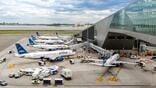
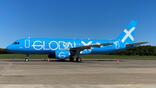
Spirit Airlines customer at Fort Lauderdale-Hollywood International Airport on May 2, 2026.
Spirit Airlines has grounded its fleet and begun winding down operations after talks over a $500 million rescue package from the Trump administration collapsed, ending more than three decades of operations for the U.S. carrier.
Spirit Aviation Holdings said it had begun an “orderly wind-down of operations, effective immediately,” grounding all flights and canceling all remaining services. Customers were told not to go to the airport as the airline shut down after failing to secure additional liquidity to continue operating. About 15,000 staff are affected.
The ULCC had been aiming to exit Chapter 11 by early summer, but the outbreak of war involving Iran sent jet fuel prices sharply higher and put that plan at risk. As pressure mounted, the airline sought federal support and by late April was in “advanced discussions” with the Trump administration over potential rescue financing. But on May 2, Spirit said no additional funding was available and that it had “no choice but to begin this wind-down.”
“For more than 30 years, Spirit Airlines has played a pioneering role in making travel more accessible and bringing people together while driving affordability across the industry,” Spirit President and CEO Dave Davis said.
“In March 2026, we reached an agreement with our bondholders on a restructuring plan that would have allowed us to emerge as a go-forward business. However, the sudden and sustained rise in fuel prices in recent weeks ultimately has left us with no alternative but to pursue an orderly wind-down of the company,” Davis continued. “Sustaining the business required hundreds of millions of additional dollars of liquidity that Spirit simply does not have and could not procure. This is tremendously disappointing and not the outcome any of us wanted.”
Spirit had been seeking a federal rescue package worth about $500 million, with the Trump administration weighing a loan package that could have given the U.S. government a substantial ownership stake. President Donald Trump said on May 1 that the administration had made Spirit a “final proposal,” but it is understood that negotiations broke down after the airline failed to secure support from key bondholders.
Spirit’s collapse caps a long decline for the Miramar, Florida-based carrier, which had spent the past two years trying to reinvent itself after the failure of its planned mergers with Frontier Airlines and JetBlue Airways. Spirit first filed for Chapter 11 protection in late 2024, emerged briefly, then reentered bankruptcy in August 2025 as it pursued a more aggressive restructuring centered on shrinking its fleet, network and labor costs.
Spirit recorded a net loss of $2.76 billion for the full year 2025, compared to a net loss of $1.22 billion in 2024, while its total operating expenses decreased by 24% year-over-year. Before suspending operations, it had 105 Airbus A320-family aircraft in service, according to CAPA Fleet Database, with another 70 aircraft grounded.
OAG Schedules Analyser data shows that the airline was due to operate 327,422 scheduled seats across 113 nonstop routes in the week commencing May 4, 2026, down from 846,736 seats and 334 nonstop routes a year ago. Fort Lauderdale, Orlando and New York LaGuardia were its largest airports by capacity.
Of the 113 nonstop routes it was still operating before its collapse, only about 15 were exclusive, meaning most of its services overlapped with competitors that can now move to absorb displaced demand. However, some routes—including Fort Lauderdale-Lima, Peru; Fort Lauderdale-San Antonio; and Fort Lauderdale-St. Thomas, U.S. Virgin Islands—will be left without any nonstop service.
Spirit Customer, Crew Support
Following its collapse, the U.S. Transportation Department (DOT), America Airlines, United Airlines, Delta Air Lines, JetBlue Airways, Southwest Airlines, Allegiant Air, Frontier Airlines, Avelo and Breeze announced measures to support impacted Spirit travelers. That includes capping ticket prices for customers with a Spirit flight confirmation number and proof of payment, and extending travel pass benefits and spare jump seats to stranded Spirit crew. American and Delta also committed to offer reduced fares on high-volume Spirit routes, DOT said, while Allegiant will freeze fares across routes that overlap with Spirit and Frontier will halve base fares across its network until May 10.
“We’ve activated our airline partners to ensure passengers are not stranded, communities maintain route access, fares do not skyrocket, and Spirit’s workforce is connected to new job opportunities,” Transportation Secretary Sean Duffy said.
United and American are also creating dedicated application portals for Spirit employees to apply to open roles, prioritizing those applications where feasible.
American noted that it serves 70 of Spirit’s 72 airports, and 67 of its routes. “We are also reviewing opportunities to add additional capacity—including utilizing larger aircraft and adding flights on critical routes—to support as many affected passengers as possible,” the carrier said. Budget rival and former would-be merger partner Frontier detailed the “rescue fares” across its network.
“Frontier currently serves more than 100 routes previously flown by Spirit and will expand further this summer with nine additional routes, plus 15 additional daily flights across 18 former Spirit markets, giving customers more options to rebook their travel plans with confidence while keeping fares low,” the Denver-based carrier said.
Spirit pioneered the ULCC model in the U.S., moving to an unbundled and no-frills service in 2007 as it began targeting nearly everything for a fee. For years, the model worked and in 2012, as Spirit’s traffic jumped nearly 21% year-over-year, its legacy rivals were devising ways to better compete. Soon, Basic Economy was introduced.
In announcing its wind-down of operations on May 2, Spirit reflected on its three decades of service. “We are proud of the impact of our ultra-low-cost model on the industry over the last 33 years and had hoped to serve our Guests for many years to come,” the carrier wrote.


Related Content