This article is published in Business Aviation & AAM Report part of Aviation Week Intelligence Network (AWIN), and is complimentary through Apr 24, 2026. For information on becoming an AWIN Member to access more content like this, click here.

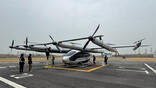
Defense logistics is a likely early use case for AIR’s uncrewed cargo eVTOL.
Israeli electric vertical-takeoff-and-landing (eVTOL) startup AIR has flown its first production heavy-lift uncrewed cargo aircraft, built on an assembly line in central Israel with the capacity to produce 60 aircraft a year.
The company is in the final stages of evaluating three sites in the U.S. for a semi-automated assembly line able to produce 300 aircraft a year initially for passenger, cargo and defense markets, says cofounder and CEO Rani Plaut. AIR has purchase orders for 25 cargo aircraft so far, he says.
The heavy-lift uncrewed cargo aircraft is the first version of the AIR One electric vertical-takeoff-and-landing (eVTOL) to enter production. The winged multicopter has a payload capacity of 550 lb. in a 70 ft3 cargo bay with an upward-opening door for loading and unloading. AIR is targeting the uncrewed version at remote resupply, contested logistics, maritime operations, humanitarian aid and commercial cargo missions. The company is also looking at the potential market for an agricultural version of the aircraft for crop spraying, Plaut says.
The two-seat AIR One has been developed for the personal eVTOL market, and the company plans to secure FAA approval for the passenger aircraft through the recent Modernization of Special Airworthiness Certification (Mosiac) revamp of light sport aircraft rules. The production design is the result of flight testing with several prototypes and features next-generation electric motors and a battery system as well as fully matured avionics with enhanced flight automation.
“We’ve spent two years refining this aircraft against real operational scenarios, not benchmarks or simulations,” Plaut says, adding that late prototypes of the cargo eVTOL are being flown by customers. While Mosaic provides a route to market for the passenger aircraft, the path for the cargo version is less clear, says Plaut. AIR is seeking the path of least resistance, he says, pursuing applications in defense—where customers can certify the aircraft themselves—and in more permissive geographies.
Singapore’s ST Engineering has purchased some of the cargo aircraft, which it labels the DrN-600 and plans to operate in parts of Asia and the Middle East where it is easier to gain approval to fly a large uncrewed aircraft, says Plaut. “In defense, we have sold some units to customers that are already using the aircraft,” he adds.
AIR has a strategy of simplicity and minimizing changes, so the passenger and cargo eVTOLs are essentially the same. The cargo aircraft has a solid canopy and lacks the firewall between the seats and luggage area in the passenger aircraft but is otherwise the same, he says. The flight control system software is identical and has a “superset” of functionality for both versions.
Initially, aircraft are being assembled manually in the Israeli plant, which has six assembly stations—four of which were seen occupied by near-complete aircraft during Aviation Week’s video interview with Plaut. The aircraft is designed for semi-automated production with Tier 1 suppliers delivering assembled and tested subassemblies. The planned U.S. plant will be designed to produce 2,000-5,000 units a year, if demand materializes.

Related Content