
This article is published in Aviation Week & Space Technology and is free to read until Nov 28, 2026. If you want to read more articles from this publication, please click the link to subscribe.

The U.S. Space Force’s initial cadre of CASR vendors offers a diverse array of sensor options for the service to harness in surge situations.
After three years of pilot programs, the U.S. Space Force has set up new agreements meant to let the service quickly tap into commercial companies’ space tracking networks in times of need.
- The Space Force taps six companies for extra domain awareness
- Initial awards will inform similar contracts for different mission areas
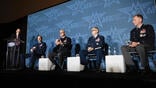
The service’s Space Systems Command recently awarded the first operational contracts under the Commercial Augmentation Space Reserve (CASR) program to six space domain awareness companies. With these initial awards, the Space Force hopes to tap into extra capacity quickly from these vendors if an unexpected event occurs on orbit, leaders of the Commercial Space Office (COMSO) told reporters Oct. 21 at the annual Space Industry Days conference in El Segundo, California.
Four of the participating companies—Anduril, InTrack Radar Technologies, LeoLabs and Slingshot Aerospace—are U.S.-based. Australia’s Electro Optic Systems Space Systems and Canada’s NorthStar Earth and Space Inc. each secured a contract as well.
The selected companies’ array of sensor options—spanning space-based optical systems, ground-based radars, orbital intelligence and data fusion and analytics products—should allow the Space Force to harness a diverse mix of options when a space event might suddenly require more tracking.
The total value of the agreements awarded is $1.37 million, a command spokesperson tells Aviation Week. The COMSO is looking at the CASR program as a pathfinding opportunity, COMSO Director Col. Timothy Trimailo told reporters. “We want to see how it works in practice, and frankly, we want to see how much our operational counterparts call upon it over the next year,” he said.
The agreements build on earlier CASR pilot efforts and were struck about one year after the service originally anticipated awarding the contracts. Slingshot, for example, participated in a CASR-related event in July 2025, says David Bailey, company vice president for U.S. sales and solutions engineering.
The new contract formalizes processes already in place through Slingshot’s work with the Joint Commercial Operations (JCO) cell, he notes—referring to a virtual unit within U.S. Space Command that fuses unclassified space domain awareness data from military, international and commercial partners.
Under the new contract, Slingshot has agreed to provide support to track orbital activities, such as an unexpected satellite breakup, or if a secondary object is released from a spacecraft, he says.
NorthStar, which has operations in McLean, Virginia, as well as Montreal, Luxembourg and Auckland, has worked with the JCO and DARPA. During surge operations, the company is capable of rapidly scaling its support to provide “sustained” space domain awareness within hours, identifying unexpected activities—such as a satellite maneuver or a close approach, NorthStar spokesperson Delanie Khan-Dobson says.
“We identify where additional observations are needed and fuse the available data to give operators a clearer, more timely picture of what is happening in space,” Khan-Dobson says.
Anduril’s contract award comes via its acquisition in March of ExoAnalytic Solutions, which first began supporting the JCO in 2021 with its distributed ground telescope network. Company Vice President of Ground Systems Doug Hendrix says Anduril’s network can be activated “at critical moments” and that it already supports operators by bolstering government systems with persistent monitoring and data insights.
The new awards have occurred as the U.S. military and intelligence communities work to integrate commercial space capabilities into government architectures. The CASR program, established in 2023, is frequently compared with the U.S. Air Force’s Civil Reserve Air Fleet, through which certain airlines are contracted to provide their aircraft for military use during a surge. While the COMSO opted to focus on space domain awareness for the first contract, the service is working on similar CASR arrangements to tap into satellite communications or launch as separate mission areas.
Each of the initial vendors holds active contracts with the JCO, has mature networks and capabilities and was previously vetted, says Lt. Col. Brandon Galindo, the office’s CASR division chief. He describes the contract as “the platinum status” for commercial space domain awareness companies, meaning “you’re so trusted that we recognize that we need to have access to you in a future fight.”
The current cohort, however, is not intended to be static. Additional companies are in the pipeline to receive contracts, and the office plans to onboard more companies on a regular basis, Trimailo says.
“This is not a chalk line that we’ve snapped that says you can never get into CASR for the space domain awareness mission,” he says. “It’s a living program. So we’re always looking for new entrants, new opportunities, new companies that have proven themselves and that are trusted partners to be part of CASR.”

Related Content



Comments