This article is published in Aviation Daily part of Aviation Week Intelligence Network (AWIN), and is complimentary through Nov 13, 2026. For information on becoming an AWIN Member to access more content like this, click here.

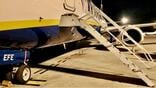
Employees open the luggage compartments of a rerouted Aer Lingus aircraft on Nov. 5, 2026, at Evreux-Fauville Air Base, France.
A wave of bomb threats disrupted commercial flights across Europe on Nov. 5, forcing diversions, military escorts and security inspections following similar incidents earlier in the week.
By 1300 GMT Nov. 5, airlines and authorities had reported threats affecting about 18 flights. They included Aer Lingus Flight EI 402 from Dublin to Rome’s Fiumicino Airport, which diverted to Évreux military air base in Normandy, France, after a threat was received en route. All 151 passengers and six crew members were taken to a secure location while military bomb-disposal teams searched the aircraft, French Prime Minister Sébastien Lecornu’s office said. Flightradar24 data showed the Airbus A320 had passed Paris before changing course, entering a holding pattern and landing at Évreux.
Three Ryanair flights bound for Sofia, Bulgaria, were also affected. Services from Copenhagen and Madrid continued to the Bulgarian capital, while a flight from London Stansted Airport was diverted to Plovdiv Airport, Bulgaria. A statement from the Bulgarian Defense Ministry confirmed that MiG-29 fighters were deployed to intercept and escort three passenger aircraft following bomb threats.
Finnair confirmed threats against two flights from Helsinki, serving Rome and Vienna, while two Wizz Air flights from Milan Malpensa Airport were targeted. Warsaw, Poland-bound Flight W4 6387 diverted to Vienna after a threat was received, while W4 3064 continued to Bucharest, Romania, because it was already approaching its destination.
LOT Polish Airlines Flight LO 235 from Warsaw to Brussels also landed safely after a threat. The airline said the crew conducted an onboard security check before landing, followed by a further inspection by authorities at Brussels Airport. “This inspection also confirmed that no hazardous or suspicious items were found,” the Star Alliance member added.
A separate LOT service from Warsaw to Paris was stopped while taxiing and moved to a designated stand, where the aircraft and baggage were screened. The flight later continued using a replacement aircraft after the search found nothing hazardous.
Elsewhere, Czech police investigated threats against four currently unidentified flights approaching Prague. A statement said “all necessary security measures” were taken and inspections found nothing suspicious. The investigation has been transferred to the Czech police’s National Center Against Terrorism, Extremism and Cybercrime.
Bomb alerts were also reported against an Aegean Airlines flight from Thessaloniki, Greece, to Milan Malpensa and a Ryanair service from Porto, Portugal, to Malpensa. There have also been reports of threats to three unidentified flights at Madrid’s Barajas Airport.
EU Transport Commissioner Apostolos Tzitzikostas stressed that it was “too early to draw conclusions on whether the reported incidents are linked,” but said that “any threats against civilians are unacceptable.”
“We are closely monitoring the situation and are in contact with the affected member states,” he said. “I have been in contact with [the] European [Union] Aviation Safety Agency today about the recent events. We discussed any potential aviation safety implications.”
“Responsibility for assessing security threats, investigating incidents and implementing appropriate aviation security measures rests primarily with the relevant national authorities, in cooperation with airport operators, airlines and law enforcement authorities,” Tzitzikostas added.
The Nov. 5 incidents follow threats against at least seven flights across Europe on Nov. 3. Aircraft operated by LOT, SAS Scandinavian Airlines, Ryanair and Wizz Air were searched after arriving or diverting to airports in Poland, Spain, Italy and Bulgaria. No devices were discovered. A day earlier, a Wizz Air flight from London Luton Airport to Sofia diverted to Budapest after receiving a threat.
Aviation risk intelligence company Osprey Flight Solutions said the Nov. 5 threats were “near certain” to be connected to those reported two days earlier and warned that further incidents were likely in the near term. However, it said the motivation, delivery method and identity of those responsible remained unclear.
Osprey said bomb threats offered a low-cost, low-risk way to cause operational disruption, divert security resources and attract widespread attention. Those responsible were likely to regard the aircraft diversions, military deployments and resulting media coverage as evidence the campaign had succeeded, it added.
The risk consultant said there was a “realistic probability” that the threats were connected to Russia’s wider hybrid campaign in Europe, potentially through criminal or other third-party actors operating at arm’s length. However, it cautioned against premature attribution, saying the incidents could instead reflect political or personal grievances and that some of the latest threats may have been copycats.
“While operational disruption and media coverage remain the most likely driver of this campaign, there is a realistic possibility that those responsible wish to degrade the aviation security response by normalizing the sending of threats,” an analyst update from Osprey said. “This is assessed as unlikely to succeed. The receiving of threats diverts resources away from potentially more legitimate threats and can result in complacency.”
“However, given the high security standards of European aviation security, it is more likely that this will refocus security protocol at airports, leading to greater scrutiny of security,” the Osprey analyst said. “A greater confidence in security measures will inform operational security and resilience teams with the decision to continue operations and normalize flights.”

Related Content